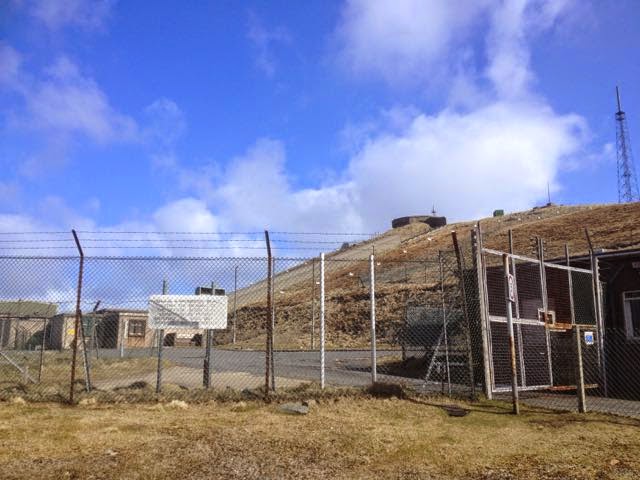
I had no idea just how big the old MOD/RAF installations on top of Saxa Vord, Unst, actually are. And how spine-tinglingly Edge of Darkness the whole bomb-proof business is. And I didn't even get to explore the tunnels!
But what views from the road that leads to what was the UK's first line of defence against Russian nuclear attack. And, rumour has it, may once again have a dome built there to house....who knows what?
Anyway, it's beautiful, historic and slightly scary. A must-see for any Unst tourist, in my opinion. Tricky road, though, be careful. Don't be distracted by Muckle Flugga!
Thursday, April 23, 2015
Tuesday, April 21, 2015
The Ballad of the Camper Van (and the RAC Man)
I’ll tell you a story, I don’t want to trouble you
I bought a camper van, a VW
I got it on eBay, in Auchinleck
A cash-on-collection, no-timewasters wreck
Resprayed, looked immaculate
MOTd, fully loaded
I was approaching Perth
When the engine exploded
In a shower of milky white
Boiling hot water
I’d been screwed. I’d been led
Like a lamb to the slaughter
The man from the RAC simply giggled
Showed how the gear linkage wobbled and wiggled
Held together with cable ties, duct tape and hope
The scales fell from my eyes, and I felt like a dope
The silicon sealing the cylinder head...
It had been “newly serviced”, the seller said
The timing belt changed, the water pump too
“But not by someone who knew what to do”
Laughed the man from the Royal Club of Automobiles
Not seeming to care a jot how I might feel
“But they did just enough to fool someone on eBay
has this happened before, sir?”
I thought, then replied “maybe
Just nine or ten times in the past 20 years…”
I remembered the agony, the blame and the tears
The moss and the fungus in that Talbot Express
From Orkney, my daughter’s awful distress.
A Fiat - it broke down in a safari park
And stranded us on the Tay Bridge after dark
The T25 that I picked up in Kent
Got to Carlisle, before I found out the chassis was bent
And you had to steer sideways to keep going straight.
The several Type Twos that I learned to hate
For their back-breaking steering, their gear changes from hell
The air-cooled motors, the constant burning smell
And the breakdowns in Cumbria, Edinburgh, Wick
My wife always shouting, the kids always sick
“So why, said the man from the RAC, are you here
With another disastrous purchase, I fear?”
I replied “It’s an addiction, a gamble, a chance
That somehow, just once out of all of those vans
I’ll find something solid and trustworthy and true
And we’ll drive off on adventures, to Katmandu
Or to Keswick (that’s in England, but only just)
Instead, I shut doors, and get showered with rust
I carry gallons of water, and Radweld, and oil
I sit on hard shoulders as radiators boil
And ponder the thousands of pounds that I’ve spent
And wonder if I’d be better off in a tent
Or how many hotel rooms could have been bought
With all I’ve invested in breakdowns and rot.”
“I’ve nothing to add to that” said the RAC chap
“Except just one thing: Your membership’s lapsed.”
Friday, March 20, 2015
Eclipsed by Shetland
Over the winter, I've wandered Northmavine with my camera set to Doom-Laden-Black-and-White-Artiness, snapping pictures of this, that and the other. But mostly the sky.
Sometimes it seems that Shetland is all sky. The low humps of the landscape, the lack of trees, the scattered humans and their occasional, crouching habitations...add some of the most extreme weather in Europe and you can find yourself unconsciously bent and cowering beneath the firmament.
I've known visitors who left swearing never to return, intimidated by what they saw as the massive, glowering threat above them, the sense of their own insignificance.
But our skies move and change, season by season, moment by moment. From the Northern Lights' strange flickering towers of night-time colour to the boiling, scudding clouds of day, the sharp beams of stark sunshine, highlighting the glint or thrashing power of the sea. I love it, winter and summer, viciously cold and blisteringly, briefly hot.
Anyway, today was to be the solar eclipse, and Shetland was promised 98 per cent of the sun obscured. Not that an obscured sun is that unusual hereabouts. Still, the moon had to do what the moon had to do, and so I prepared a flask of coffee and climbed the Clave, the highest point of the Hillswick Ness. I changed the camera's setting to Rock-Star-Rayban-Facing-Flashgun mode and waited. Proper coffee, Vietnamese full roast from The Longship in Orkney. It was cold and gusty, but the sky...the sky was in full, playful try-and-keep-up mood.
I'd woken to stillness, thick sea mist and low cloud. By the time the moon was ready to do its thing, there were patches of blue sky and a scudding north-westerly wind moving things along briskly. Add the occasional squally cloud and rainstorm, and...
I sat on the overgrown concrete base of an old wartime radio mast, drank Java and marvelled as the sun blinked, the eclipse showed itself coyly among the clouds, and Northmavine, Shetland and its ever-altering skies remained as miraculously beautiful as ever.
Nothing can eclipse that.
![]() |
| Elcipse, 20 March 2015 |
Sometimes it seems that Shetland is all sky. The low humps of the landscape, the lack of trees, the scattered humans and their occasional, crouching habitations...add some of the most extreme weather in Europe and you can find yourself unconsciously bent and cowering beneath the firmament.
I've known visitors who left swearing never to return, intimidated by what they saw as the massive, glowering threat above them, the sense of their own insignificance.
But our skies move and change, season by season, moment by moment. From the Northern Lights' strange flickering towers of night-time colour to the boiling, scudding clouds of day, the sharp beams of stark sunshine, highlighting the glint or thrashing power of the sea. I love it, winter and summer, viciously cold and blisteringly, briefly hot.
![]() |
| Eclipse skyscape,The Clave, Hillswick Ness |
Anyway, today was to be the solar eclipse, and Shetland was promised 98 per cent of the sun obscured. Not that an obscured sun is that unusual hereabouts. Still, the moon had to do what the moon had to do, and so I prepared a flask of coffee and climbed the Clave, the highest point of the Hillswick Ness. I changed the camera's setting to Rock-Star-Rayban-Facing-Flashgun mode and waited. Proper coffee, Vietnamese full roast from The Longship in Orkney. It was cold and gusty, but the sky...the sky was in full, playful try-and-keep-up mood.
![]() |
| Newmoonsun |
I'd woken to stillness, thick sea mist and low cloud. By the time the moon was ready to do its thing, there were patches of blue sky and a scudding north-westerly wind moving things along briskly. Add the occasional squally cloud and rainstorm, and...
![]() |
| Obscured |
I sat on the overgrown concrete base of an old wartime radio mast, drank Java and marvelled as the sun blinked, the eclipse showed itself coyly among the clouds, and Northmavine, Shetland and its ever-altering skies remained as miraculously beautiful as ever.
Nothing can eclipse that.
Wednesday, March 04, 2015
Welcome to Shetland: My 'Shetland Showcase' speech, 3 March 2015
A very special welcome to those here who are visiting the isles. Those whose money and resources we wish to appropriate.
I hope you’ve all had a pleasant and interesting day, and I’m sure you’ve enjoyed the wonderful food. Shetland possesses some of the greatest seafood and mutton in the world, though I personally was thankful tonight not to be served raans - cod roe - or sheep’s heid, with seared fleece, which I have had, and is like eating burnt knitwear. Perhaps some other time. Those boiled eyelids have to be cooked...just right,
Shetland has its own beer, its own gin, will soon at last have its own whisky, and as you will have noticed, has some of the best weather in the northern hemisphere. You’ll have seen the forests of palm trees swaying gently in the wind.
It’s also a place of invention. Smallpox inoculation began here, courtesy of the man known as Johnnie Notions. Erving Goffman invented modern micro sociology after a summer spent working on the island of Yell. And of course, the internet was invented in Scalloway. Or to be precise, a peerie bit of it was. It is alleged that 'power circuit networking' was invented by an engineer in Scalloway - that’s the business of using home electrical circuits to send your broadband from room to room. I’ve been told that this was an accidental discovery made when one BT engineer wired a telephone into the mains by mistake.
But when I put this to BT management they said it was, and I quote, a shocking allegation.
Anyway what I thought I might do tonight is recite a few poems, and use these to introduce our visitors to some aspects of Shetland life they may not have come across before, or which may be mystifying them. And to start off, I thought I’d tackle the question of the Shetland beard. The beard is of course, a highly desirable, if not essential component of the Up Helly Aa festivities, though it can pose certain risks. Who can forget the great Guizer Jarl chin conflagration of 1958, and the consequent banning of Vaseline to provide added shine to one’s manly growth? When used along with Samson rollies...
Beardopolis
Welcome to Shetland, land of the beard
Where weak jawlines are made to disappear
And chins, quadruple down to double
Sprout wispy, weedy down, or fearsome stubble
The kind that leaves a rash or even scars
The casual kisser, or removes the paint from cars
Should face and body work collide
Some small refreshment having been imbibed
It can take many months, or even years
To grow a quite convincing Viking beard
And would-be Norsemen, filled with fear and doubt
Their naked chins refusing to sprout
Resort to desperate measures, pills and ointments
To counter any hairless disappointment
Hormone supplements, consumed in quantities
So vast, they've opened special pharmacies
Male pattern baldness, fought by men down south
Means nothing here. It's whiskers round the mouth
Which mark the man of honour, poise and strength
No wonder here we'll go to any length
Those bristles to obtain
We'll suffer any pain
Abrasion with sandpaper will
Used with a Black and Decker drill
Stimulate, I'm told those Viking follicles
It's a fact, historical, absolute and true
It worked for me. I pray it works for you
Now as you’ve been shown around Shetland, you will have encountered our excellent transport system. Often known as ‘roads’. There are two potholes in Shetland, one in the Co-op car park in Brae, one in the Co-op car park in Lerwick. That one actually takes up most of the Co-op Car Park in Lerwick. But there is the question of the ultimate Shetlandic vehicle. What is it? It can only be one thing...
The Pickup
Once this addiction starts
I cannot stop
I need an Ifor Williams top
Though never will a sheep
Or dog, woman or child,
Scratch my tailgate
I hate the thought
Of grubby paws, or bags of Tesco shopping
Scarring the luscious Mitsubishi sheen
I've been there. I had a HiLux once,
A crew cab, with roll-bar, shotgun rack
Springsteen, Steve Earle and Daniel O'Donnel tracks
Rang in my ears
It ended in tears
A wife, a collie, trips sooth to IKEA
Talk of baby seats and daft ideas
About trading in for a Citroen Picasso or worse
A Vauxhall Zafira
I did not hear her
For I was gone, long gone
Working offshore in Venezuala
My relationship a failure
But I raised the cash for this
Shiny Barbarian, with leather seats
The sound so sweet
Of its diesel engine in my ears
Crankshaft and gasket failure fears
Assuaged. (That was the early L200 years)
And so I drive from North Roe down to Sumburgh
And back, in clement weather
I'll wash her with the finest shammy leather
And in the heated garage
Stroke her gently
She's better than a Bentley
Or Nissan, or Toyota
Not one iota of regret
Do I feel
This love is real
I count my blessings and my luck
In finding you, my one true pick up truck
My L200
My precious! Do not fear
I'll never overrev you in third gear!
During the referendum campaign, which you may (or may not) remember, a journalist came to see me. Indeed, I used to work for him, when I too was a journalist, before I became a light entertainer. He had come to Shetland as part of a 'state of the nation' tour of Scotland, and I was happy to make him some lunch, introduce him to my two St Bernards, give him a cloth to wipe the drool off his expensive Edinburgh breeks. He wrote a fairly innocuous piece at the time, and it wasn’t until a few weeks ago, in a column, that he revealed how he much he hated Shetland, hated we who live here, hadn’t enjoyed his lunch and was forced to throw away his trousers due to the acidic qualities of St Bernard slobber. But there was another reason, I felt, why he didn’t like Shetland. He got a knockback, apparently, in Posers.
Or rather, from Posers. Posers is a nightclub. Posers is THE Shetland nightclub. And what a name that is! Worthy of Ibiza. Or Orkney. When I first came to the isles, almost 30 years ago, I was used to Glasgow nightclubs and when I was told by my wife to be we were going to one in Shetland I dressed accordingly - Levi 501s, polished Docs, Cruise leather jacket. So we got to the door, and the bouncer said - sorry sir, you can’t come in wearing that. Or those. I was forced to remove my jacket and my shoes, and put on a pair of strange funeral Grand Hotel brogues. I walked in and the first thing I saw was two guys at the bar, wearing boiler suits and wellington boots.
Edinburgh Man Hates Shetland
Edinburgh man hates Shetland!
Too much building work,
Too many cranes and bulldozers
Besides, they wouldn't let him into Posers
Not dressed like that
In Boden and Hackett
You'll have to remove that jacket, sir
And, indeed, all your clothes
It speaks of values we don't share
Look, we have Fair Isle you can wear
(Admittedly a little itchy
As underwear
But it's compulsory). Soothmoothers must learn
To love the constant rubbing, the knitwear burn
On naked skin
You'll soon fit in
Scar tissue forms quite quickly
True, you may feel sickly for a while
But smile. And have a dance
It's a Boston two step!
Now's your chance!
You see, how stimulating
Wool on bare skin can be?
You'll recover soon
It's just minor surgery
Just one final verse, and this one concerns my own assimilation into the ways of Shetland fashion. The padded lumberjack shirt. The Dickies jeans. The unavailable-anywhere-else Wolsey Bri-nylon underwear. Guaranteed to provide enough static electricity to power the average pacemaker.
The Zetlandic Fashionista
What a relief
When I came to this place
To wear comfortable trousers
With elasticated waists
No need for ties
Or Armani suits
You could go to the Jubilee
Wearing Wellington boots
Preferably white
With optional fish scales
Or yellow, but not black or green
Those would fail
Any bouncer’s test
And for boiler suits
Blue was the best
Under the black light
It looked kind of cool
But no leather jackets
That was the rule
Because leather was evil
Leather was bad
It made people violent
It made people mad
Back in the days before
Jaegermeister, Magners or Aftershock
It was leather made young people
Knock off each other’s blocks
Now we slump on sofas
In pullups and baffies
Lerwick still has one nightclub
And 27 cafes
Commercial Street runs with
Lattes and capuccinos
Councillors are wearing
Hugo Boss and Moschino
Still, I wear North Eastern Farmers
And LHD proudly
And play Daniel O'Donnell records
At home now
Quite loudly.
And now....to Posers!
Tuesday, February 24, 2015
The Seahouse (extended 12-inch version)
This is a (much) longer version of the story kindly published by the excellent Caught by the River website.
Sand bags are not bags of sand, not in this neck of the bog. They are bags of grit, bags of gravel, sacks of small stones. Sand, sharp sand, builder's sand? That would wash away, like the beaches sometimes do, sucked in and spat out by the biggest tides, wiped out by the wind.
The council has supplied us with gritbags, stonebags, gravelbags, and they are piled around the front door like the clusters of dead sheep you sometimes see, huddled against snowdrifted walls, revealed by the thaw. We wait.
We wait for the top of the tide. We wait for the flood.
We've done our best with this 300-year-old former Church of Scotland manse. The massive rock armouring along the shoreline was diggered in after the last major flood, in the late 1970s, when seawater was lapping a foot from the Rayburn's top, according to Lornie, who was there, bailing, perched atop the stove with a bucket. The big stone house crouches on a beach, a shingle peninsula, just six metres or so from high water mark. And these days, the highest of high tides, the springs, are level with our doorstep on a calm day. So we have built extra walls, channels, drains and runnels to deal with the malevolent storm surges that come with a couple of days of big Atlantic swells, building far out in the ocean and a wind of a particular, vicious bent. A westerly's the one to watch for, when it starts backing, and great slurping, sloshing surges begin walloping around the bay. That's when you're looking at trouble. Or at night, listening for it, waiting.
The cast-iron Rayburn stove is a religion, surrounded by ritual, fear, hope, faith, deliverance, eternal hellfire. We burn peat, cut from our own banks. Sustainable? Probably not, not over 100,000 of your earth years, but more so than the Government-subsidised wood that is now fashionable and cheap on this treeless archipelago. Peat is local, hand-harvested over a backbreaking spring and summer. Peat is history. I'm thinking of Gunnister man, the 18th-century traveller found in mummified near perfection by cutters just a mile or two away. I'm thinking of ‘blue’ peat, the coal-like treasure that burns quickly and very hot, and the wet slabs of turf used to damp a fire that threatens to run out of control. Peat tar coats chimneys and if the lum catches, usually on a windy night, it's like some kind of nuclear inferno that can, and does, melt stone.
This third-hand Rayburn, a Series 1 Landrover to a suburban Aga's Range Rover Vogue, can be fine-tuned to handle the worst storm in the world. We’ve learned how to deal with it, finally, after hard, costly lessons involving the fire brigade, disastrous and dangerous sweeping attempts and leaking water jackets. Now, it's hurricane proof. All flaps are closed. It's our servant, not our flue-destroying master. Chim Chim Cheree! Water is croaking and bubbling in the backboilers, up the copper pipes to the radiators we bought from the old Peterhead Prison.
Tonight, it feels like the worst storm in the world is with us. But then, it often feels that way. In the downstairs toilet, the WC is waterless, the wind creating low pressure that sucks it dry. I pour a bucket down, for emergencies. It disappears in seconds.
It's been dark since 2.35pm. There will be a brief flicker of low, oppressive daylight around 9.30am. Or maybe tomorrow will never lighten beyond a kind of permanent dusk. Whatever, we're in proper, northern winter darkness, the TV up high so it's audible above the storm. Blink. Blackness. Bleeping from the uninterruptible power supplies I use to keep the broadcasting and computer gear going if I'm on air, giving me time to get the generator, going, out in the washhouse. It's a Honda. I've never bought anything but Honda outboards and generators since a terrifying chase after a boat that had snapped its mooring, and was being sent lurching furiously towards Iceland by a nasty wee squall. I jumped from the pursuing salmon farm tender into my beloved Shetland Model, and said a prayer to Soichiro-San that his, and my three-year old outboard motor would start. It did.
I'm not on the radio tonight. And besides this is now a west-south-westerly force 11, gusting higher. Towards 100 mph or so, too high and from the west, so getting to the washhouse through the porch’s sliding door is dangerous, maybe impossible. Time to check the candles, torches, make a last cup of tea from Rayburn-boiled water. All switches off, the stove tamped right down. Check the phone - still working. Susan, a GP, is on-call for emergencies, 24-hours availability. NHS Direct? Be serious. A final prayer for no call-outs, and so to bed amid the groaning, muttering, howling and rattling of this old, old house. The windows are solid, double glazed, built by a local firm from (sustainable) hardwood. When they were fitted, when the old ones were removed, the original frames were revealed as recycled ship's spars, complete with adze-marks and cleats. The beams under the kitchen slabs are pitch pine, 300 years old or more, and when they were cut for central heating pipes the smell of sap was as fresh as Domestos.
The phone doesn't ring. We sleep sound and unmoving. Gunnister Man and Woman. It's the silence that wakes us.
Late, veering towards nine, the first dark blue signifier of morning, the wind, the sky, the world has dropped. As the atmospheric pressure has lifted, the sense of oppression, of greater gravity has increased. The air is jellied, thick, all movement is slow and sluggish. And the world has changed. Things have shifted, been rearranged, like God playing stroppily with someone else's Lego. Everything has been slowed and stunned by the violence of the storm
By 10.30, you can see, dimly, through windows frosted with salt. The grass is covered with shingle and stones. Susan's car has a smashed quarterlight - the Landcruiser’s interior is all glass and shingle. The peat stack has been levelled, scattered, and there is wave-borne bruk right up to the front door. Tangle and kelp everywhere. It's like the ocean has been on some almighty bender, has vomited its guts out. Now it needs to sleep. Until the next time. There’s a menacing stillness to the waveless water of St Magnus’ Bay.
There is seaweed all round the washhouse door. But the Sea House is still standing, just as it always has, as it probably always will. I pull on the Honda’s starting cord, and the building bursts into life.
(Bruk: Shetland dialect, rubbish or detritus; lum - chimney; Shetland Model - an open, double-ended boat.)
Sand bags are not bags of sand, not in this neck of the bog. They are bags of grit, bags of gravel, sacks of small stones. Sand, sharp sand, builder's sand? That would wash away, like the beaches sometimes do, sucked in and spat out by the biggest tides, wiped out by the wind.
The council has supplied us with gritbags, stonebags, gravelbags, and they are piled around the front door like the clusters of dead sheep you sometimes see, huddled against snowdrifted walls, revealed by the thaw. We wait.
We wait for the top of the tide. We wait for the flood.
We've done our best with this 300-year-old former Church of Scotland manse. The massive rock armouring along the shoreline was diggered in after the last major flood, in the late 1970s, when seawater was lapping a foot from the Rayburn's top, according to Lornie, who was there, bailing, perched atop the stove with a bucket. The big stone house crouches on a beach, a shingle peninsula, just six metres or so from high water mark. And these days, the highest of high tides, the springs, are level with our doorstep on a calm day. So we have built extra walls, channels, drains and runnels to deal with the malevolent storm surges that come with a couple of days of big Atlantic swells, building far out in the ocean and a wind of a particular, vicious bent. A westerly's the one to watch for, when it starts backing, and great slurping, sloshing surges begin walloping around the bay. That's when you're looking at trouble. Or at night, listening for it, waiting.
The cast-iron Rayburn stove is a religion, surrounded by ritual, fear, hope, faith, deliverance, eternal hellfire. We burn peat, cut from our own banks. Sustainable? Probably not, not over 100,000 of your earth years, but more so than the Government-subsidised wood that is now fashionable and cheap on this treeless archipelago. Peat is local, hand-harvested over a backbreaking spring and summer. Peat is history. I'm thinking of Gunnister man, the 18th-century traveller found in mummified near perfection by cutters just a mile or two away. I'm thinking of ‘blue’ peat, the coal-like treasure that burns quickly and very hot, and the wet slabs of turf used to damp a fire that threatens to run out of control. Peat tar coats chimneys and if the lum catches, usually on a windy night, it's like some kind of nuclear inferno that can, and does, melt stone.
This third-hand Rayburn, a Series 1 Landrover to a suburban Aga's Range Rover Vogue, can be fine-tuned to handle the worst storm in the world. We’ve learned how to deal with it, finally, after hard, costly lessons involving the fire brigade, disastrous and dangerous sweeping attempts and leaking water jackets. Now, it's hurricane proof. All flaps are closed. It's our servant, not our flue-destroying master. Chim Chim Cheree! Water is croaking and bubbling in the backboilers, up the copper pipes to the radiators we bought from the old Peterhead Prison.
Tonight, it feels like the worst storm in the world is with us. But then, it often feels that way. In the downstairs toilet, the WC is waterless, the wind creating low pressure that sucks it dry. I pour a bucket down, for emergencies. It disappears in seconds.
It's been dark since 2.35pm. There will be a brief flicker of low, oppressive daylight around 9.30am. Or maybe tomorrow will never lighten beyond a kind of permanent dusk. Whatever, we're in proper, northern winter darkness, the TV up high so it's audible above the storm. Blink. Blackness. Bleeping from the uninterruptible power supplies I use to keep the broadcasting and computer gear going if I'm on air, giving me time to get the generator, going, out in the washhouse. It's a Honda. I've never bought anything but Honda outboards and generators since a terrifying chase after a boat that had snapped its mooring, and was being sent lurching furiously towards Iceland by a nasty wee squall. I jumped from the pursuing salmon farm tender into my beloved Shetland Model, and said a prayer to Soichiro-San that his, and my three-year old outboard motor would start. It did.
I'm not on the radio tonight. And besides this is now a west-south-westerly force 11, gusting higher. Towards 100 mph or so, too high and from the west, so getting to the washhouse through the porch’s sliding door is dangerous, maybe impossible. Time to check the candles, torches, make a last cup of tea from Rayburn-boiled water. All switches off, the stove tamped right down. Check the phone - still working. Susan, a GP, is on-call for emergencies, 24-hours availability. NHS Direct? Be serious. A final prayer for no call-outs, and so to bed amid the groaning, muttering, howling and rattling of this old, old house. The windows are solid, double glazed, built by a local firm from (sustainable) hardwood. When they were fitted, when the old ones were removed, the original frames were revealed as recycled ship's spars, complete with adze-marks and cleats. The beams under the kitchen slabs are pitch pine, 300 years old or more, and when they were cut for central heating pipes the smell of sap was as fresh as Domestos.
The phone doesn't ring. We sleep sound and unmoving. Gunnister Man and Woman. It's the silence that wakes us.
Late, veering towards nine, the first dark blue signifier of morning, the wind, the sky, the world has dropped. As the atmospheric pressure has lifted, the sense of oppression, of greater gravity has increased. The air is jellied, thick, all movement is slow and sluggish. And the world has changed. Things have shifted, been rearranged, like God playing stroppily with someone else's Lego. Everything has been slowed and stunned by the violence of the storm
By 10.30, you can see, dimly, through windows frosted with salt. The grass is covered with shingle and stones. Susan's car has a smashed quarterlight - the Landcruiser’s interior is all glass and shingle. The peat stack has been levelled, scattered, and there is wave-borne bruk right up to the front door. Tangle and kelp everywhere. It's like the ocean has been on some almighty bender, has vomited its guts out. Now it needs to sleep. Until the next time. There’s a menacing stillness to the waveless water of St Magnus’ Bay.
There is seaweed all round the washhouse door. But the Sea House is still standing, just as it always has, as it probably always will. I pull on the Honda’s starting cord, and the building bursts into life.
(Bruk: Shetland dialect, rubbish or detritus; lum - chimney; Shetland Model - an open, double-ended boat.)
Labels:
Caught by the River,
Scotland,
Shetland,
storm
Subscribe to:
Posts (Atom)


